


What are the biggest Manufacturing Trends of 2026?
In 2026, the manufacturing landscape has moved beyond traditional digitization into the era of cognitive production. The focus has shifted from mere operational efficiency toward autonomous decision-making and self-optimizing systems. After years of experimental pilots, the industry has reached a definitive inflection point where smart initiatives are no longer optional—they are the primary requirement for navigating a volatile global market.
To remain competitive, manufacturers must balance high-tech autonomy with the human-centric principles of Industry 5.0, ensuring that automation enhances rather than replaces human ingenuity. Simultaneously, the transition requires fortifying infrastructure against increasingly sophisticated cybersecurity threats. This roadmap explores the 11 key trends transforming factories from reactive production sites into proactive, cyber-physical ecosystems.
1: Agentic AI & The Continued Rise of Smart Manufacturing
In a 2025 survey by Deloitte, 80% of manufacturers surveyed plan to invest 20% or more of their improvement budgets in smart manufacturing initiatives.
While AI and smart manufacturing have been the talk of the industry for years and a featured part of our manufacturing trends report each year, 2026 marks a major turning point: the move from AI that simply "thinks" to AI that "acts." This is known as Agentic AI, and it is set to redefine what a smart factory can do.
Unlike traditional AI, which typically analyzes data and waits for a human to take the next step, Agentic AI is designed with goal-oriented reasoning. It can sense a problem, plan a solution, and take action autonomously. According to Deloitte’s 2026 Manufacturing Industry Outlook,this technology is moving rapidly from small pilot programs to full-scale production.
Why Agentic AI is a Game-Changer

In a modern manufacturing environment, things move fast. A late shipment or a machine breakdown can throw an entire week’s schedule into chaos. Agentic AI acts as a "digital teammate" that can handle these hurdles in real-time without needing constant human supervision. Best of all, it never sleeps.
Here are a few ways Agentic AI is transforming the shop floor:
- Self-Healing Supply Chains: If a supplier faces a disruption, these AI agents can automatically identify and engage with alternative suppliers to keep production moving.
- Capturing Tribal Knowledge: As experienced workers retire, Agentic AI can observe their workflows and autonomously generate standard operating procedures (SOPs) and shift handover reports, ensuring vital skills aren't lost.
- Autonomous Maintenance: AI agents can monitor equipment health and proactively coordinate repairs, even ordering the necessary parts before a breakdown occurs.

Pro Tip: To get the most out of any AI, don’t just automate your old processes. Use this technology to redesign how work gets done and allow it to handle routine decisions and translate instructions while your human workforce can focus on high-level strategy and innovation.
2: The Jump to Physical AI
Wait, we already talked about AI, right? Yes, but as we said before, AI advancements and investments will be huge in 2026. The advantages of agentic AI lead to our second manufacturing trend of 2026: Physical AI.
Agentic AI is bridging the gap between digital insights and physical execution. Instead of simply using AI algorithms within software, physical AI becomes the driver of physical machines and devices, like vehicles, cobots, and even autonomous humanoid robots.
While the automated machinery of the past possessed a semblance of AI (sensors and intelligent scripts that reacted when a person entered its workspace), these older manufacturing cobots were largely limited to performing fixed tasks within a rigid and well-structured framework of rules.
In 2026, physical AI is taking on a whole new level of possibilities.
- Spatial Intelligence: Thanks to advanced 3D vision, robots no longer just "see" pixels; they understand objects. If a part is slippery or a path is blocked by a person, the machine/robot plans a new route or adjusts its grip in real-time.
- Natural Language Interaction: Workers can now give verbal commands like, "Help me move these crates to the loading dock," and the AI agent handles the logic, plans the movement, and executes the task.
- Unstructured Environments: This new wave of AI thrives in "brownfield" sites (older, messy factories). Because they can navigate clutter and adapt to unexpected obstacles, these autonomous systems are finally practical for every shop floor, not just high-tech labs.
If this is the first time you are hearing about this new wave of AI, you are not alone. While 2026 marks an important shift in capability, the transition to fully autonomous operations will likely be a gradual evolution rather than an immediate overhaul. According to projections from UBS, the integration of humanoid robots into the global workforce is expected to follow a long-term growth curve:
- By 2035: Early adoption is expected to reach roughly 2 million humanoids in the workplace with a market value of $50 million.
- By 2050: As this technology becomes a standard part of industrial infrastructure, that number is predicted to surge to 300 million units globally, market value of $1.7 trillion.
While these figures are substantial, they highlight that Agentic and Physical AI are multi-decade trends that are only just beginning to move from the research lab to the shop floor.
3: Industry 5.0 & the Connected Worker
While Trends 1 and 2 focus on the rise of autonomous "thinking" and "moving" machines, our third manufacturing trend brings the focus back to the most critical asset on the factory floor: the human worker. In 2026, we have officially entered the era of Industry 5.0, a shift from purely technology-driven automation to human-centric collaboration.
The goal is to use advanced technologies to augment human ability. According to Fortune Business Insights, the global Industry 5.0 market is projected to reach $115.32 billion in 2026, fueled by this demand for systems that unite automated efficiency with human creativity.
Industry 5.0 recognizes that while AI is excellent at processing data and robots are perfect for repetitive labor, they lack the critical thinking, intuition, and complex problem-solving skills of a human. Instead of an “AI-first" approach, 2026 is about "People-first, Tech-supported" manufacturing.
Statistics show that this synergy is a massive productivity driver. Manufacturers implementing human-centric Industry 5.0 technologies report a 30% increase in workforce productivity and a significant decrease in time spent searching for critical production data.
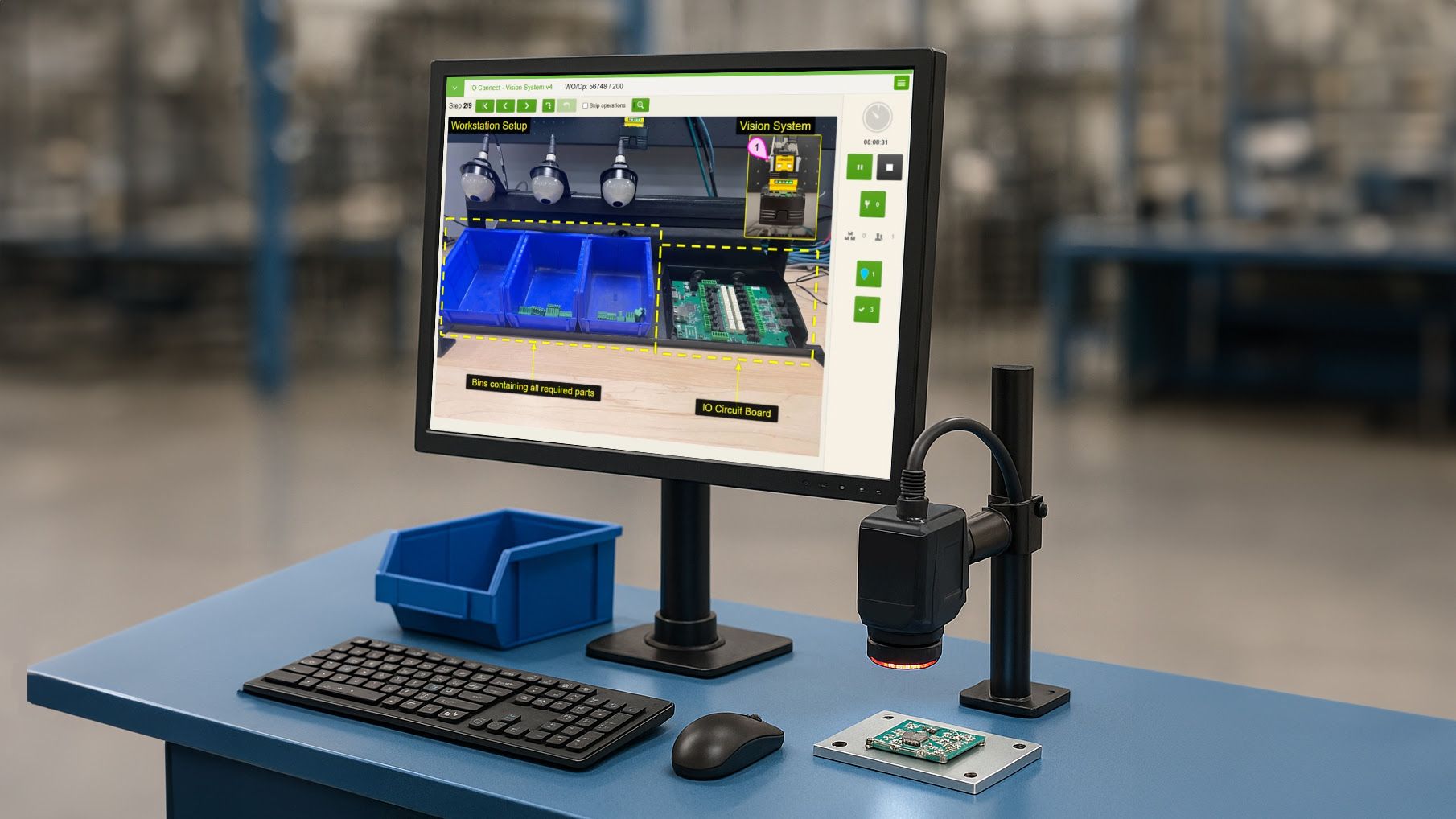
Here is how Industry 5.0 is augmenting, not replacing, the workforce:
- Cognitive Augmentation: Rather than relying on memorization, workers use real-time digital guidance. This transforms junior operators into experts instantly, allowing them to focus on high-level quality rather than manual navigation.
- Unified Hardware Integration: The ultimate evolution of the connected worker is the cyber-physical loop. Advanced platforms now act as a digital middleman, allowing work instructions to communicate directly with PLCs, pick-to-light sensors, AI vision systems, cobots, and smart tools. The system can automatically push settings to a tool, validate a task is complete, and auto-advance the worker to the next step.
- Safety & Precision Guardrails: Connected environments act as digital safety nets. By integrating sensors and vision systems, the factory becomes aware of the worker, alerting them to incorrect tool use or hazardous zones to prevent accidents and rework.
4: Adaptive Workforce Planning to Curb Labor Shortages
The primary challenge for 2026 remains the workforce, specifically, the disconnect between rapid industry growth and the availability of skilled labor. While the industry has successfully surpassed pre-pandemic employment levels, the sheer volume of new facilities and "mega-projects" has created a permanent structural labor gap.
The 2026 Workforce Challenges
- The Scalability Gap: While employment has risen to nearly 13 million, the rapid expansion of data centers and semiconductor plants is siphoning off technical talent. Manufacturers are struggling to scale their workforce at the same rate as their physical infrastructure.
- The Institutional Knowledge Drain: The "Great Retirement" continues to pose a threat. Manufacturers are losing decades of legacy knowledge faster than they can train new hires, making the "skills gap" a knowledge-transfer crisis.
- The Shift to Digital Roles: As 80% of executives invest heavily in smart manufacturing, the definition of a "factory worker" has changed. The industry now requires a workforce capable of managing AI agents and sophisticated robotics, creating a new "digital skills gap."
How Manufacturers are Solving These Issues in 2026
According to Deloitte, in 2026, the strategy has shifted to "Adaptive Workforce Planning", a model that integrates AI and robotics alongside human talent to ensure production goals are met despite a tightening labor market.
- Implementing Upskilling: Manufacturers are investing in the real-time upskilling of their existing workforce. In a recent study, over a third of respondents stated that offering training and upskilling opportunities to their employees has helped them retain their workforce.
- Capturing Legacy Knowledge Digitally: To solve the skills gap, companies are using Industry 5.0 tools like work instruction software to capture and share their institutional knowledge with the next generation of workers.
- Deploying Agentic and Physical AI: Manufacturers are bridging the labor gap with Agentic and Physical AI. By leveraging AI agents for cognitive tasks, like autonomous troubleshooting, and robots for physical labor, companies will minimize the need for human intervention in repetitive tasks, freeing their team to focus on innovation and problem-solving.
- Leveraging Ecosystem Partners: Manufacturers are turning to external partnerships to secure specialized manufacturing expertise and know-how. By relying on the expertise of partners, companies can quickly fill critical gaps in their technological infrastructure without the overhead of permanent hires, ensuring they stay ahead of the technological curve without increasing overhead in the long run.
Pro Tip: Did you know new hires can use AI-powered interfaces to receive step-by-step guidance, based on a company’s best practices and standard procedures? This drastically reduces the time it takes for a new employee to become skilled, easing the pressure of high turnover rates.
5: Increase in Onshoring and Localized Production
While the disruptions of the early 2020s are a memory, 2026 has brought a new set of challenges: an era of "weaponized trade" defined by aggressive blanket tariffs and volatile trade policies. According to NAM’s Manufacturers’ Outlook Survey,, 78% of manufacturers now cite trade uncertainty as their top concern, with many expecting input costs to rise by over 5% this year alone.
In response, our next manufacturing trend will see the industry shift from seeking the cheapest labor to achieving supply chain autonomy. Cheap offshore labor was once the primary goal, but as tariffs on major exporters like China approach 150% and local wages triple, the "offshoring discount" is quickly vanishing.
By returning production to their home countries and/or moving production closer to their intended market, companies can take greater control of how they source their materials and how they manufacture their products.
The 3 major benefits of onshoring are:
- Lower transportation costs: The major cost-saver of onshoring is through reducing the distance the product needs to travel. In the past few years, US automotive manufacturers like Ford and Tesla have progressively been establishing their own domestic supply chains for this very reason.
- Decreased lead times: Less transportation also means faster lead times, meaning that companies can bring their products to market sooner, potentially beating out competitors with offshore operations.
- Enhanced quality control: When production is closer to the base of operations, companies can implement greater oversight and ensure precise quality and consistency.
Pro Tip: Whether suppliers are nearby or on the other side of the world, there are technological opportunities for companies to tighten up their supply chains. Share your work instructions with your affiliated suppliers through a digital ecosystem, ensuring that all materials and equipment are up to snuff before they get shipped. Plus, with instant translation powered by AI, companies can instantaneously share their process requirements with any supplier in any language.
6: "Power-of-Two" Sourcing
To further help navigate the growing problems of “offshoring”, manufacturers are adopting "Power-of-Two" sourcing, a strategy that moves away from single-source dependency in favor of dual, regionalized networks. Instead of one global supplier, companies are establishing one primary domestic source and one "nearshore" partner to ensure production never stops, regardless of new tariff announcements. For example, nearshore opportunities for companies located in the USA will be with suppliers in Mexico or Canada.
Benefits and Key Drivers:
- Policy-Driven Reshoring: Government incentives continue to be the backbone of this regionalization with programs like the CHIPS and Science Act and the Inflation Reduction Act (IRA).
- Tariff Mitigation: By producing goods within the USMCA zone, companies can avoid the "tariff shocks" that hit international shipments, preserving their margins.
- Decreased Lead Times: Shortening the physical distance between the supplier and the factory floor allows for "tactical speed," enabling companies to pivot production in days rather than months.
- Reduced Cognitive Load: With AI-driven trade analytics monitoring regional routes, managers spend less time "firefighting" global logistics and more time on high-level strategy.
7: Semiconductors Drive Global Investment
In 2026, one manufacturing trend we can’t ignore is the international focus on building more semiconductors.
The semiconductor industry has moved beyond the supply chain recoveries of previous years into a massive, structurally defined growth phase known as the Silicon Super-Cycle. Global semiconductor revenue is projected to approach a staggering $975 billion in 2026, driven by an unprecedented demand for AI-first architectures and the Physical AI revolution we discussed in manufacturing trends 1 and 2.
This trend is defined by a shift from "efficiency-first" global trade toward a "security-first" national infrastructure. Nations are now treating semiconductor capacity as essential national infrastructure, leading to a surge in localized construction. In the United States, the momentum from the CHIPS and Science Act remains a primary driver, with over $32 billion in federal incentives already allocated to major players like TSMC and Intel to onshore advanced logic and memory production. For instance, TSMC has significantly scaled its Phoenix-based operations, recently announcing plans to increase its U.S. investment to over $100 billion to meet domestic demand.
And the resurgence of investment doesn’t stop there. In mid-2025, private sector commitments to revitalize the domestic chipmaking ecosystem have exceeded $500 billion. This massive scale of investment is projected to triple domestic manufacturing capacity by 2032.
This industrial expansion is expected to generate more than 500,000 jobs across the United States, spanning construction, engineering, and advanced manufacturing. Further driving this momentum, the One Big Beautiful Bill Act has enhanced the advanced manufacturing investment credit, raising it from 25% to 35%. This policy change significantly strengthens the financial incentives for companies to establish and expand high-tech fabrication facilities within U.S. borders.
8: Preemptive Cybersecurity & Resilience
As the manufacturing sector accelerates its investment in agentic and physical AI, the pursuit of digital transformation and smart manufacturing necessitates a parallel advancement in cybersecurity resilience. By 2026, Gartner predicts that cybersecurity will shift from a defensive IT function to a core "production uptime" strategy. The whitepaper highlights that the convergence of IT (Information Technology) and OT (Operational Technology) creates new vulnerabilities, requiring a focus on Cyber-Physical Resilience to protect autonomous assembly lines from catastrophic disruption.
The financial stakes of this trend were underscored by a massive cyber incident at Jaguar Land Rover (JLR). Precisely timed to coincide with the high-stakes September 1 release of new "75-plate" vehicle registrations, a peak sales period in the UK, the attack was a form of strategic business warfare. JLR was forced to halt production at its two largest UK facilities, Halewood and Solihull. Operations were paralyzed from August to October, incurring a staggering estimated loss of £50 million per week.
To counter these sophisticated threats, Gartner identifies Digital Provenance and Multiagent Systems as key strategic trends for 2026. Digital Provenance provides an immutable audit trail of manufacturing data, ensuring that the instructions sent to robots or AI agents have not been tampered with.
Furthermore, 2026 will see the rise of Preemptive Cybersecurity, where AI-driven multi-agent systems autonomously detect and neutralize threats in under 10 milliseconds, long before they can impact the physical shop floor.
For the modern manufacturer, digital maturity means being fortified. Companies that fail to invest in OT-specific security risk the complete cessation of their physical output.
9: The Industrial Metaverse Creates Zero-Downtime Planning
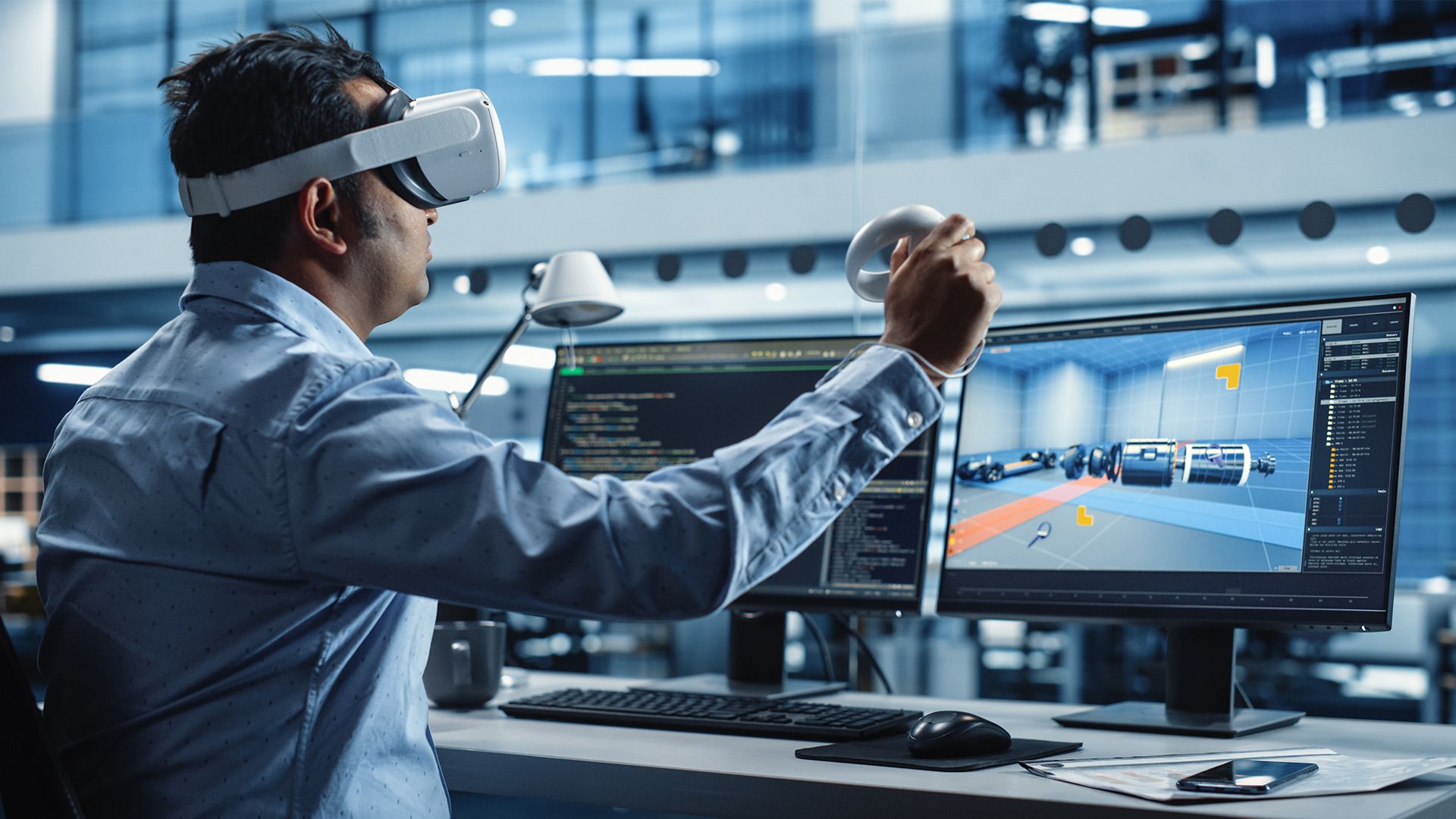
The industrial metaverse combines smart factory and digital twin technology to create an immersive virtual or virtual/physical environment. These environments are accessed using Virtual Reality (VR), Augmented Reality (AR), and/or Mixed Reality (MR) systems.
- If using AR technology, a person could walk through a physical space while a digital environment is layered over top.
- If using VR technology, the user explores a virtual environment that they observe, move, and interact with, potentially in ways that would be physically impossible.
- If using MR technology, digital and physical elements interact with each other in real time.
In theory, an infinite number of people and systems can inhabit and share a virtual space where they can communicate, work, and even play. And the manufacturing industry is excited about the possibilities of this new technology.
Before, the industrial metaverse was largely viewed as an experimental frontier. It was seen as a high-tech playground for pilots and proofs of concept. However, as we move into 2026, another use is beginning to emerge: Zero-Downtime planning.
Using metaverse technology, manufacturers are simulating entire production shifts within the metaverse to identify and rectify bottlenecks, mechanical clashes, and human-factor errors before a single machine is activated in the physical world.
And it looks like we’re only just beginning to find new and innovative uses for this technology. Statista projects that the global metaverse market will reach $507.8 billion by 2030, growing at an expected CAGR (2025-2030) of 37.43%.
The metaverse enables manufacturers to successfully close the physical distance between global teams. Experts anywhere in the world can now converge in a shared digital space to troubleshoot real-world production issues, connecting the manufacturing landscape with unprecedented speed. In this new era and under this manufacturing trend, the most resilient manufacturers are those who "fail" virtually so they can succeed physically without interruption.
10: Clean Manufacturing & Proof of Sustainability
In 2026, the industry is shifting away from the era of "green goals" and into the era of Proof-of-Sustainability. While manufacturers have long pursued carbon neutrality, simple efforts are no longer enough.
The modern consumer is now hyper-vigilant, acting as a grassroots regulator. Recent data confirms that 72% of respondents are actively seeking environmentally friendly products. Furthermore, research from PwC highlights a significant market opportunity. 80% of consumers are willing to pay a premium for sustainably sourced goods, with many prepared to pay up to 9.7% more for brands that can back up their eco-friendly claims.
However, because unverifiable green labels have eroded public trust, 2026 marks the end of vague marketing. It is no longer sufficient to state that a product is "green"; companies must now provide a digital audit trail.
And governments around the world are enacting measures to make this happen.
- Digital Product Passports (DPP): In the EU, consumers will be able to scan a QR code that provides machine-readable data on its origin, material composition, carbon footprint, and repairability.
- Climate Corporate Data Accountability Act (SB 253): California is setting a global standard for manufacturing data. SB 253 requires large companies (over $1B revenue) doing business in California to report their emissions starting in 2026.
This digital green trail transforms sustainability from a PR initiative into a core operational requirement. By integrating IoT sensors and AI-driven emissions monitoring, factories can now generate real-time proof of impact on their labels. These digital certifications serve as the ultimate decision-making factor at the point of sale, offering the transparency that 2026 consumers demand.
Pro Tip: Environmental certifications, such as ISO 14001, can help manufacturers reduce their carbon footprint. It is also a signal to consumers that your company takes these issues seriously, giving you a competitive advantage in the environmentally conscientious market.
11: Circular Manufacturing
In 2026, Circular Manufacturing has shifted from a niche sustainability initiative into a core business strategy designed to decouple industrial growth from resource consumption. Driven by rising material costs, geopolitical supply chain volatility, and stricter global regulations like the EU's Ecodesign for Sustainable Products Regulation (ESPR), manufacturers are embedding circularity into their primary operating systems. A primary example is the Automotive and Transportation sector, where some manufacturers are redesigning products to ensure high-value materials can be reclaimed.
The foundation of the 2026 circularity is Design for Disassembly (DfD). Modern automakers are moving away from permanent welding and chemical adhesives toward modular components and reversible fasteners, such as bolted or clipped connections.
This approach allows authorized treatment facilities to easily remove and reuse parts without the energy-intensive processing required for traditional recycling. For instance, by redesigning mechanical interfaces and adopting circular manufacturing, companies can increase material savings by 60% in some cases.
Mercedes-Benz has recently opened a new plant that can recycle 96% of EV batteries, enabling the company to recover materials such as lithium, nickel, and cobalt.
Are You Ready for 2026?
In 2026, the most prevalent manufacturing trends are defined by autonomy and sustainability. Shifting toward Agentic AI and circular models is more than an upgrade; it’s a redesign to survive trade volatility and resource scarcity.
Despite economic and regulatory pressures, 2026 offers immense opportunities, enabling manufacturers to transform previous volatility and fledgling technologies into methods for sustained growth and competitiveness.